OpenAI AgentKit & Workflow Builder: A Shake-Up for Automation
OpenAI is taking automation to a new level: with the Workflow Builder and AgentKit, you can build intelligent AI processes right inside the OpenAI platform. No third-party tools, no code chaos. This article explains what's behind it, how startups can benefit and why tools like n8n need to reposition themselves.

Daniel Traut, Co-founder
8 min read
A Quiet Shift in the World of Automation
OpenAI has quietly introduced a tool that is likely to make big waves: the Workflow Builder, part of the new AgentKit.
What looks like a developer feature at first glance is really a major challenge to platforms like n8n, Zapier or Make, because OpenAI is building directly into its own platform what used to require an entire tech stack.
So what exactly is this Workflow Builder?
And can it really replace the established tools startups use to run their automations and AI processes?
The OpenAI Workflow Builder: A Toolkit for Real Intelligence
The new AgentKit bundles everything you need to build autonomous AI agents:
A visual development environment, API integrations, guardrails, monitoring and automated evaluation.
Instead of writing code or wiring up third-party tools, you design your AI workflows directly on platform.openai.com – much like a flowchart, but with real intelligence at its core.
That makes something possible that used to take a whole combination of tools:
A fully integrated workflow, from input through logic to output.
OpenAI itself says that with AgentKit, companies can go from idea to implementation "in a sprint instead of a quarter."
When OpenAI Becomes the Orchestrator: Why n8n Suddenly Has Competition
In recent years, n8n has become synonymous with "automation without programming."
With its node-based interface, hundreds of integrations and self-hosting options, it's a fixture in many startups' tech stacks.
But OpenAI has a decisive advantage:
It controls the heart of most modern automations – the language model itself.
Because the Workflow Builder runs directly inside the OpenAI ecosystem, you avoid:
- latency from API hops
- external evaluation tools
- complicated connectors and triggers
And this is where it gets interesting:
If OpenAI offers the same flexibility as n8n – but with deeper integration and less friction – a real shift is coming.
What the New Builder Means in Practice: An AI Call Assistant
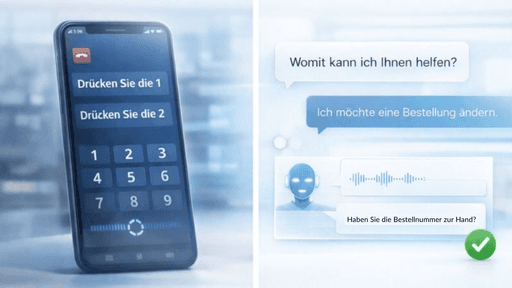
Let's take a practical example: an AI phone assistant that answers calls, understands conversations, books appointments and classifies requests.
Until now, that meant a patchwork of tools – such as Twilio, n8n, the OpenAI API and database logic.
With the new Workflow Builder, the flow looks like this:
- Incoming callSpeech recognition via Whisper (speech-to-text)
- Intent detectionGPT analysis within the workflow (e.g., appointment booking, question, complaint)
- Data retrievalThe agent accesses the CRM or calendar through a connector
- ResponseGenerated response → text-to-speech → played back to the caller
- Follow-upThe call log is automatically analyzed and scored (via "Evals")

All of this runs inside a visually designed workflow that lives directly on the OpenAI platform.
No makeshift setup, no external server, no wrestling with JSON – just true end-to-end intelligence.
Why the Difference Only Shows on Second Glance
You might think: "n8n can do that, too."
Yes – but not quite.
Because with AgentKit, OpenAI brings together capabilities that used to be scattered:
- Quality measurement and optimization: through built-in evaluations (response analysis, scoring, tuning)
- Security logic and access control: native guardrails and team roles
- UI components: embeddable in products via ChatKit
- Context management: central storage of conversation and agent state
In short:
While n8n is a control center, OpenAI wants to become the factory where intelligence gets built.
Why Nobody Should Jump Ship Just Yet
Even though OpenAI simplifies a lot, n8n remains a strong tool – especially in hybrid setups:
| Scenario | n8n wins | AgentKit wins |
|---|---|---|
| Multi-provider flows (e.g., Slack, HubSpot, Google Sheets) | ✅ | ❌ |
| Self-hosting and full data control | ✅ | ❌ |
| Deep OpenAI integration and evaluation | ⚠️ | ✅ |
| Speed of prototyping | ⚠️ | ✅ |
| Cost at high volumes | ✅ | ⚠️ |
So the reality won't be "either/or" but "both/and."
Startups in particular could benefit by keeping orchestration logic in n8n while building critical AI components directly in OpenAI.
What Does This Mean for Founders and Developers?
If you work with n8n, Zapier or Make today, ask yourself three questions:
- How central is OpenAI to my setup?If GPT models are already the core of your automation, the Workflow Builder is worth a look.
- How much do I depend on control and self-hosting?AgentKit is cloud-only (for now) – if you need full control over your infrastructure, you're better off sticking with n8n.
- How often do I change or optimize my flows?For fast-moving projects, the visual builder with built-in testing offers huge advantages.
When AI Starts Running Its Own Processes
One exciting aspect of the new builder is not just what it automates, but how:
In the future, OpenAI models will be able to evaluate, improve and reconfigure their own workflow steps.
In other words: processes that optimize themselves.
For voicebots and call assistants, that could be revolutionary.
An agent that notices after 100 calls which phrasing calms customers down – and automatically uses it from then on – used to require tedious prompt tuning.
Now it happens natively in the system.
The Big Picture: From Workflows to Systems That Think
With AgentKit and the Workflow Builder, OpenAI makes it clear where things are headed:
From automating individual steps to the autonomy of entire systems.
What gives startups an edge today will soon be standard, and tools like n8n will have to reinvent themselves to keep up.
But instead of panicking, developers should see this as an opportunity:
Infrastructure gets leaner, learning cycles get shorter, and access to real AI productivity has never been easier.
The most exciting line from OpenAI's announcement sums it up best:
"We're moving from building tools to building builders."

With AgentKit and the Workflow Builder, OpenAI is entering a new market: end-to-end automation. Until now, everything revolved around models, prompts and APIs. Now it's about complete solutions – systems that think, act and improve themselves.
For many companies, this means they can control every part of an AI product from a single platform for the first time: from data retrieval and decision logic to evaluation.
That's more than convenience – it's the step from "prompting" to thinking in terms of productive agents. With this move, OpenAI is claiming the space that integration platforms and middleware startups have occupied so far.
And that's exactly what makes it so exciting: Instead of combining 5 tools, a single platform that brings it all together natively is suddenly enough.
Where the opportunities and risks lie
As fascinating as that sounds, it also brings new challenges. If you move all of your automation onto OpenAI's infrastructure, you gain speed and stability – but you also give up control. For data-driven startups and regulated industries in particular, striking a balance between convenience and independence will be crucial.
Those who strike that balance can get huge benefits out of AgentKit: Shorter development cycles, faster iterations and AI systems that keep refining themselves with every input.